

Introduction
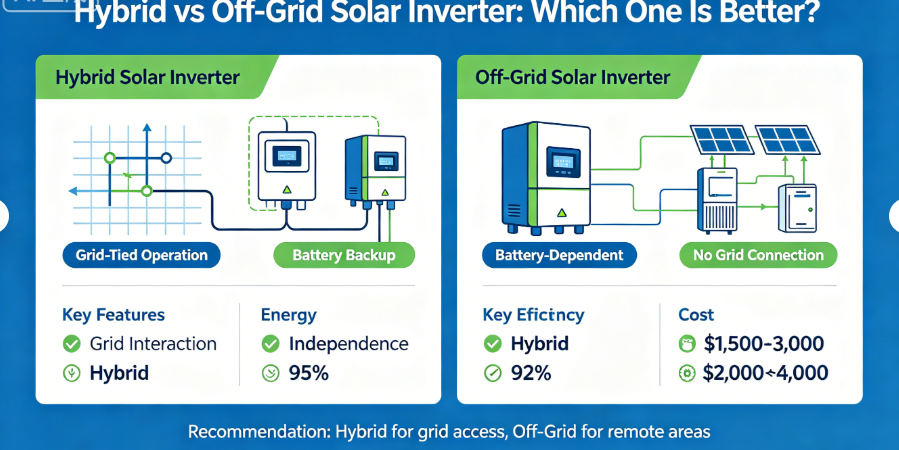
Hybrid and off-grid solar inverters are often confused, but they serve different purposes. Choosing the wrong type can lead to higher costs and poor system performance.
This article compares hybrid and off-grid solar inverters to help you decide which one is better for your application.
1. What Is an Off-Grid Solar Inverter?
An off-grid inverter:
-
Works without utility power
-
Requires batteries
-
Is ideal for remote locations
Pros:
-
Complete energy independence
-
Reliable in areas without grid
Cons:
-
Higher battery cost
-
Limited scalability
2. What Is a Hybrid Solar Inverter?
A hybrid inverter:
-
Connects solar panels, batteries, and grid
-
Automatically switches power sources
-
Supports energy storage
Pros:
-
Backup power during outages
-
Grid interaction
-
Flexible system design
Cons:
-
Slightly higher initial cost
3. Comparison Table
| Feature | Hybrid Inverter | Off-Grid Inverter |
|---|---|---|
| Grid Support | ✅ Yes | ❌ No |
| Battery Required | Optional | Required |
| Backup Power | ✅ Yes | ✅ Yes |
| Best Use Case | Home & Business | Remote Areas |
4. Which One Should You Choose?
-
Choose off-grid inverter if you live far from the grid
-
Choose hybrid inverter if you want backup power and future flexibility
Most homeowners and small businesses prefer hybrid solar inverters.
FAQ
Q: Can a hybrid inverter work without batteries?
A: Yes, it can operate as a grid-tied inverter.
CTA
👉 Need help choosing between hybrid and off-grid inverters?Aninerel provides customized solar inverter solutions for different applications.