

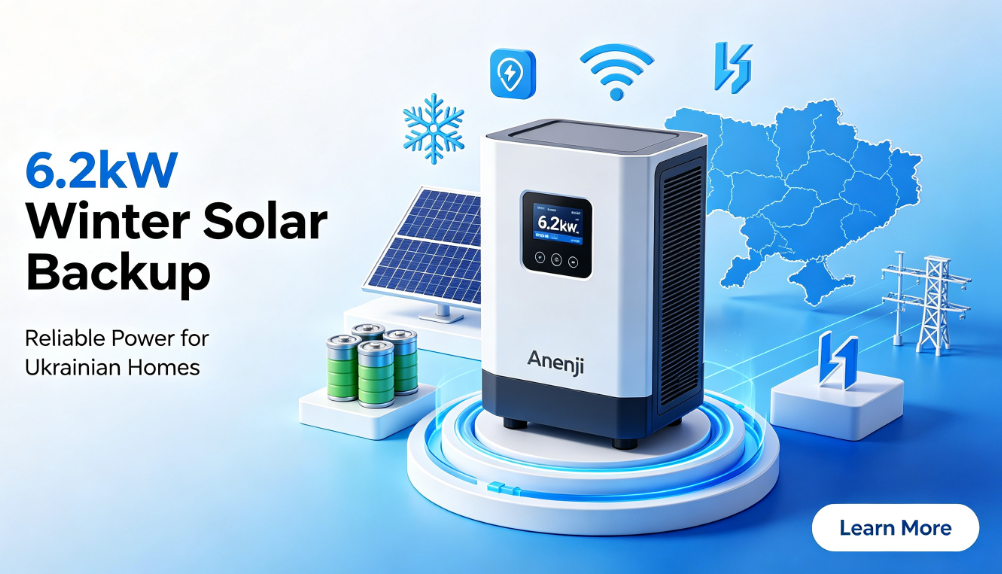
Introduction: Surviving Ukraine’s Dual Crisis – Damaged Grid And Freezing Winter
👉 Official product link: https://aninerel.com/products/6-2kw-power-hub-inverter
Years of repeated strikes against Ukraine’s critical energy infrastructure have crippled national power capacity, creating a persistent energy deficit of up to 6 GW each heating season. Rolling scheduled and emergency blackouts across Kyiv, Lviv, Kharkiv, Odesa and rural villages regularly run 6‑12 hours, and multi‑day total outages occur after substation damage.
Meteorologists predict record‑cold winter conditions for 2026‑2027, with regional lows falling to ‑18 °C to ‑22 °C. Without reliable electricity, electric radiators, water circulation pumps, refrigerators, internet routers and life‑sustaining medical equipment stop working. For households with elderly residents, children or chronically‑ill family members, prolonged power loss poses direct health risks.
Ordinary grid‑tie solar inverters shut down completely the moment mains power fails. Noisy diesel generators demand scarce expensive fuel and constant maintenance. That is why hybrid on‑off‑grid inverters have become essential home survival hardware across Ukraine.
The Anenji 6.2 kW Power‑Hub Hybrid Inverter is built to cope with Ukraine’s unstable grid, cold climate and emergency blackout scenarios. It combines grid‑tied self‑consumption, true off‑grid UPS‑mode backup, built‑in high‑current MPPT solar charger and smart load management. Stocked in Anenji’s Poland warehouse for fast cross‑border DDP shipment into Ukraine, it has become a popular mid‑range choice for private houses, cottages and small farm households preparing for winter emergencies.
1 Key Features Tailored For Ukraine Wartime & Cold‑Winter Real‑World Conditions
1.1 UPS‑Grade <10 ms Automatic Grid‑Battery Transfer
When public power collapses suddenly after infrastructure damage, this unit switches over to battery‑solar power in under 10 milliseconds. Fridges, heating circulators, medical oxygen devices and lighting do not flicker or power off. This near‑instant transition is critical for Ukrainian homes relying on continuous essential loads during unplanned blackouts.
1.2 Wide Operating Temperature For Ukrainian Frost
Designed for Eastern European harsh climate: operating range ‑20 °C ~ +60 °C. Many budget imported inverters lock up or derate output below ‑5 °C. The Anenji Power‑Hub uses reinforced internal hardware and smart thermal management, maintaining full rated performance even through severe snow‑storm freezes.
1.3 Integrated High‑Efficiency MPPT Solar Charger
Wide PV voltage window maximizes energy harvest during Ukraine’s short, overcast winter daylight hours. It rapidly charges battery banks on grey snowy days, building stored energy for overnight and multi‑day blackouts. Supports generous PV oversizing up to match typical Ukrainian residential rooftop solar arrays.
1.4 Dual‑Priority AC Load Outputs For Emergency Power Saving
Two separate AC output terminals distinguish critical loads (heaters, fridges, medical gear, router) and non‑essential appliances. When battery level drops low during extended outages, the inverter automatically disconnects secondary loads to preserve power for life‑supporting household equipment – a vital function for long winter blackouts when sunlight is limited.
1.5 Multiple Selectable Working Modes
- SBU Solar‑Battery Priority: For off‑grid / heavy‑blackout zones; solar and batteries run home loads first, grid only acts as emergency backup.
- SOL Solar Priority: Grid‑connected homes, maximize solar self‑consumption to lower utility bills.
- UTL Utility Priority: Makes use of cheap off‑peak grid electricity to pre‑charge batteries ahead of forecast rolling blackouts.
Also supports battery‑less mode, useful for temporary emergency backup if battery storage is not yet installed.
1.6 WiFi Remote Mobile Monitoring
WiFi connectivity lets homeowners remotely check solar generation, battery state‑of‑charge and household power draw via smartphone. Holiday‑cottage owners or people working in the city can review system status without travelling out into freezing winter weather. Receive alerts for grid failure and low battery levels.
1.7 Full‑Set Safety Protections For Damaged Ukrainian Grids
Local power networks suffer frequent voltage swings, surges and under‑voltage events. Built‑in protections include overload, short‑circuit, over‑temperature, reverse‑polarity and anti‑islanding safety compliance for grid‑connected operation.
1.8 Poland‑Warehouse DDP Delivery To All Ukrainian Regions
Inventory held in the EU Poland fulfilment centre with simplified customs transit via Poland‑Slovakia border routes:
- Western Ukraine (Lviv, Ivano‑Frankivsk): 4‑6 working days
- Central Ukraine (Kyiv, Vinnytsia): 5‑7 working days
- Eastern / Southern Ukraine (Kharkiv, Odesa): 7‑9 working days
DDP all‑in pricing, no surprise VAT or customs brokerage fees upon arrival. Full CE certification documentation included for Ukrainian renewable‑energy loan and grid‑connection applications. Standard 2‑year manufacturer warranty; limited‑time sales events offer extended warranty up to 3 years, with faulty units replaced from EU stock – no requirement to ship hardware back to China.
2 Verified Real‑World User Reviews From Ukrainian Homeowners & Installers
🇺🇦 Review 1 – Yuriy K., Kyiv suburban private house
Last winter our suburb had scheduled blackouts 8‑10 hours every day, and after one missile strike on a nearby substation we lost grid power fully for three days with temperatures dropping to ‑17 °C. Before buying the Anenji 6.2 kW Power‑Hub I used a cheap imported inverter that would throttle power and shut down once temperatures went below ‑7 °C. This hybrid unit switches to battery backup so fast you cannot even see the lights blink. We kept our electric radiators, fridge and my wife’s oxygen‑concentrator running non‑stop. I use the phone app to watch battery levels while I work downtown. Delivery from Poland arrived in five days with all customs paperwork complete. CE documents made applying for the state solar loan straightforward. For Kyiv families getting ready for another difficult winter, this inverter is worth every hryvnia.
🇺🇦 Review 2 – Halyna M., mountain cottage owner, Ivano‑Frankivsk
Our mountain cottage sits in a region repeatedly hit by energy‑infrastructure strikes. Winter temperatures often hit ‑19 °C. The utility room is unheated, so any electronics must survive heavy frost. We installed the Anenji 6.2 kW Power‑Hub paired with lithium battery storage last autumn. The dual‑load separation feature saved us during a week‑long blackout in February: the inverter turned off washing‑machine and air‑conditioner loads automatically to preserve power for heating and food refrigeration. The WiFi app is very convenient since we only visit the cottage on weekends. Shipment crossed the border smoothly in six days, zero hidden charges. Much more reliable than cheaper inverters shipped directly from China.
🇺🇦 Review 3 – Oleksandr V., rural farm owner, Lviv region
On our remote farm grid power is unstable year‑round. Previously we relied on a noisy diesel generator, fuel is expensive and hard to source in winter. We fitted the Anenji Power‑Hub to our existing solar panels and battery bank. Even on heavily overcast short‑winter‑sunlight days the MPPT controller charges our batteries well. We run water pumps, farm lighting and our home heating. I especially value the battery‑less test mode we used during installation. Poland‑warehouse stock meant we avoided long multi‑week lead‑times from China. Technical support answers during European working hours, no inconvenient time‑zone delays.
🇺🇦 Review 4 – Serhiy P., local solar installer, Vinnytsia
I have completed over a dozen residential solar‑backup projects using the Anenji 6.2 kW Power‑Hub for clients across central Ukraine. Local grids have constant voltage fluctuations and emergency blackouts in every cold season. Customers most appreciate the instant UPS transfer that keeps medical and heating loads alive during sudden grid loss. All supplied CE documentation passes DSO grid‑inspection requirements on first submission. Fast EU‑warehouse delivery helps us meet tight pre‑winter installation deadlines. Compared against premium European‑brand hybrid inverters of equal cold‑climate performance, Anenji cuts total project costs significantly. I regularly recommend this model for family‑home wartime‑backup solar systems.
3 Anenji 6.2 kW Power‑Hub VS Cheap Direct‑China‑Shipped Hybrid Inverters (Ukraine Buyer Comparison)
表格
| Comparison Item | Anenji 6.2 kW Power‑Hub (Poland‑Warehouse) | Low‑Cost Uncertified Inverters Shipped Direct China |
|---|---|---|
| Minimum stable operating temperature | ‑20 °C | Typically ‑5 °C ~‑10 °C, shutdown in heavy frost |
| Grid‑battery transfer speed | <10 ms UPS‑level, no load interruption | 500‑2000 ms lag; heaters / medical gear cut‑out |
| Winter‑day MPPT solar‑harvest performance | Optimized for low‑irradiance overcast conditions | Poor charging efficiency in short‑winter‑sunlight |
| Ukraine delivery & customs | 4‑9 days DDP all‑inclusive | 15‑35 days transit + unexpected customs surcharges |
| Grid‑connection / subsidy documentation | Complete official CE test‑reports included | Incomplete paperwork, risk of subsidy rejection |
| Warranty service | Poland‑local unit replacement | Must return faulty hardware to China (30+ day turnaround) |
| Remote monitoring | Multilingual WiFi mobile app | Often only basic English‑only interface |
4 Best‑Suited Installation Scenarios In Ukraine
- 🏡 Private suburban homes (Kyiv, Odesa): backup heating, refrigeration and internet for scheduled wartime rolling blackouts
- 🏔 Remote mountain cottages & western‑Ukraine rural houses subject to frequent infrastructure strikes
- 🌾 Small family farms: water‑pump, livestock‑lighting and residential heating backup
- 🩺 Households with elderly residents, infants or patients requiring continuous‑running medical electrical devices
- 💻 Home‑office setups that cannot afford power loss for work‑from‑home operations
- 🔧 Local solar‑installer projects for pre‑winter emergency energy‑preparation
5 FAQ Optimized For Google Featured‑Snippet & Ukrainian High‑Intent Search
Q1 Can Anenji 6.2 kW Power‑Hub run electric heating loads during Ukrainian‑‑18 °C winter blackouts?
A1: Yes. It maintains full rated 6.2 kW continuous output down to‑20 °C ambient temperature. It can simultaneously support multiple electric radiators, water‑circulation pumps, refrigerators and critical lighting during multi‑day wartime‑caused grid outages.
Q2 Is this inverter acceptable for Ukrainian solar‑loan applications and grid registration?
A2: Yes. Each unit ships with complete independent‑laboratory CE LVD / EMC certification, datasheets and declaration‑of‑conformity documents, accepted by Ukrainian energy authorities for distributed‑PV registration and renewable‑energy financing.
Q3 What is delivery time from the Poland warehouse to Ukraine?
A3: Orders ship within 48 hours of payment: Western‑Ukraine 4‑6 working‑days; Kyiv‑central‑region 5‑7 working‑days; Eastern‑Southern regions 7‑9 working‑days. All‑in DDP pricing includes VAT and import duties with zero unexpected border‑side fees.
Q4 Does it work without batteries?
A4: Yes, it supports battery‑less mode for limited emergency functions, but the fast UPS automatic‑backup during blackouts requires a compatible battery bank to operate. For real‑world winter blackout survival you will need matched LiFePO4 or lead‑acid battery storage.
Q5 What battery types are compatible?
A5: Works with 48‑V class LiFePO4, gel and AGM lead‑acid battery banks widely available on the Ukrainian market. RS485 communication supports BMS integration for lithium‑iron‑phosphate packs.
Q6 What warranty is offered for Ukrainian buyers?
A6: Standard 2‑year manufacturer warranty processed via the Poland EU warehouse. During promotional sales events customers receive free extended warranty up to 3 years. Faulty replacement units ship from EU stock; no expensive cross‑border returns to China.
Final Conclusion
As Ukraine braces for another difficult wartime winter with forecast record‑low temperatures and repeated risk of large‑scale energy‑infrastructure attacks, reliable hybrid solar inverters are more than an upgrade – they represent home emergency‑survival infrastructure.
The Anenji 6.2 kW Power‑Hub hybrid inverter delivers the critical capabilities Ukrainian households require: sub‑zero‑cold stable performance, UPS‑grade instant transfer to keep heating and medical gear online, smart priority load management for long blackouts, good winter‑low‑light solar‑harvesting, remote WiFi monitoring and Poland‑warehouse fast DDP delivery with complete subsidy‑compliant certification.
It balances solid emergency‑ready performance and competitive pricing, outperforming both high‑priced Western‑European brand hardware and risky slow‑shipped uncertified budget imports from China.
If you are building or upgrading your solar‑storage system ahead of the coming winter blackout season, review full specifications, real‑time stock status and promotional pricing on the official store page: 👉 https://aninerel.com/products/6-2kw-power-hub-inverter