

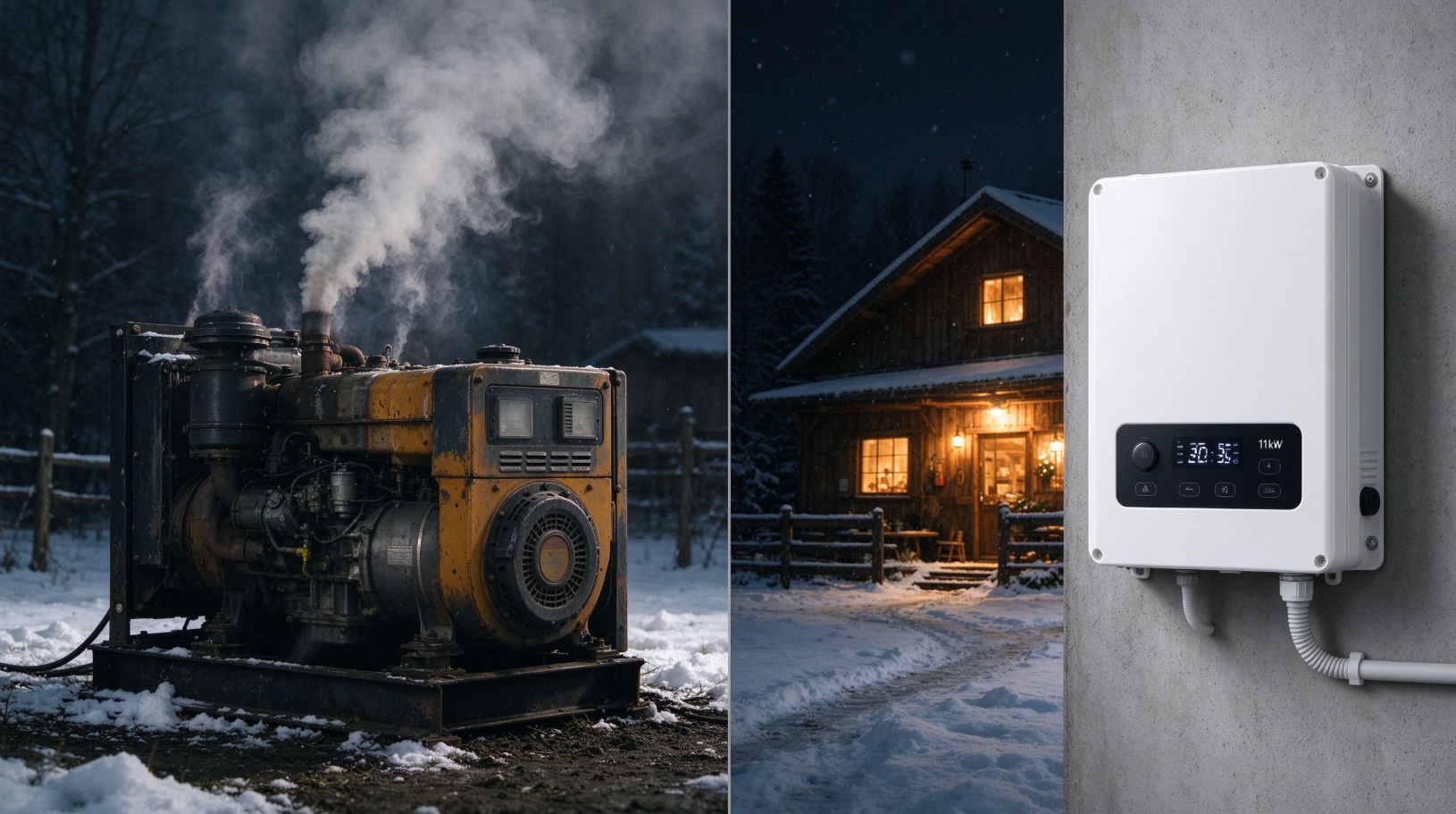
Ask any Ukrainian who survived the 2025–2026 heating season what was worse: the cold, the blackouts, or the diesel generator sitting in the yard. You will get a familiar answer.
Diesel generators were the emergency purchase of last winter. Thousands of Ukrainian farms, villas and guesthouses bought them when the grid collapsed. By spring, most owners had a war story to tell:
- Fuel prices spiked as supply chains were disrupted, and some farmers spent tens of thousands of hryvnias running a generator through a 5‑day outage.
- The noise was unbearable — a constant rattling that ruined sleep, annoyed neighbors and broke the peace of mountain guesthouses.
- The fumes were dangerous indoors. Carbon monoxide poisoning scares forced people to run generators in freezing garages or uncovered yards.
- Maintenance was endless: oil changes, air filters, broken pull cords, dead starters.
- Generators failed when you needed them most — on the coldest night, after sitting idle for weeks.
This winter (2026–2027), with forecasts of ‑18 °C to ‑22 °C and another year of damaged energy infrastructure, Ukrainian large‑property owners are making a different choice. They are switching to solar + battery + the Aninerel 11kW dual‑MPPT hybrid inverter — and the numbers explain why.
1 The Diesel Generator Math Everyone In Ukraine Is Now Running
Let’s do the math that every Ukrainian farm and villa owner has calculated in the last 3 months.
表格
| Cost Factor | Diesel Generator (10kW) | Aninerel 11kW Solar System |
|---|---|---|
| Upfront hardware | €1,500–2,500 | €2,500–4,000 (inverter) + panels + batteries |
| Fuel cost per 100 hours running | €800–1,200 (at current diesel prices) | €0 (free sunlight) |
| Annual maintenance (oil, filters, repairs) | €200–400 | Near zero (sealed LiFePO4, no moving parts) |
| Indoor safety | Fumes, CO risk, must run outside | Silent, zero fumes, indoor‑safe |
| Noise | 70–90 dB, neighbor‑killer | <35 dB, library‑quiet |
| Lifespan | 3–5 years heavy use | Inverter 10+ years; batteries 6000+ cycles |
| Blackout autonomy | Limited by fuel supply | 1–5 days on battery + solar recharge |
| Resale value | Drops fast as generators wear | Holds value; modular expandable |
| Green tariff / subsidies | None | Eligible for Ukrainian solar grants |
The Aninerel system costs more upfront, but it pays for itself in one winter if you were running a diesel generator 100+ hours. After that, the power is free. And you never again wake up at 3 a.m. to the smell of diesel and the rattle of a generator in sub‑zero weather.
2 What The Aninerel 11kW Actually Does That A Diesel Cannot
2.1 It runs silent, indoors, all night
A diesel generator at 3 a.m. in January is a war crime against your family’s sleep. The Aninerel 11kW sits in a utility room and hums quietly — quieter than a refrigerator. You can run it in an apartment, a nursery, a guesthouse bedroom floor below. No fumes, no exhaust, no carbon monoxide risk. For guesthouses and family homes, this alone is worth the switch.
2.2 It never runs out of fuel
A diesel generator is only useful if you have fuel in the tank. In wartime Ukraine, fuel stations run dry, convoys are delayed, and prices spike. The Aninerel system charges from solar panels by day and from the grid when it is available — you never need to queue for diesel. Even on a 3‑day snowy outage, the battery bank and panel array keep power flowing.
2.3 Dual MPPT harvests Ukrainian winter sunlight
The Aninerel 11kW has two independent MPPT trackers — each optimizing a separate solar array. On the east‑west roofs common to Ukrainian villas and farms, this captures 15–25% more winter solar than a single‑tracker inverter. A diesel generator cannot harvest sunlight at all; it burns money while a solar system builds free stored energy.
2.4 It protects your expensive equipment
A diesel generator delivers dirty, fluctuating power that damages heat pump controllers, well pump VFDs, laptop power supplies and TV electronics. The Aninerel outputs pure sine wave — identical to grid power. Your heat pump, your medical devices, your business equipment all run safely. Ukrainian farmers have burned out thousands of well‑pump controllers on generator power. The Aninerel eliminates that risk.
2.5 It qualifies for Ukrainian solar subsidies
Unlike a diesel generator (which is a pure expense), a grid‑tied solar system with the Aninerel inverter qualifies for Ukrainian state solar loans, green tariff feed‑in, and renewable energy grants. The CE documentation passes DSO inspection first time. You are not just buying emergency backup — you are investing in an asset that reduces your grid bills for 10+ years.
3 Real Ukrainian Owners Who Switched From Diesel To Aninerel
🇺🇦 Review 1 — Bohdan M., family farm, Lviv region
"Last winter we ran a 12kW diesel generator for 6 weeks straight during the worst outages. Fuel cost us more than the generator itself. The noise made our farm hands quit — they couldn’t sleep. And in January, at ‑18°C, the generator’s starter died at 2 a.m. during a 4‑day blackout. We sat cold for 36 hours waiting for a repair part. We sold the diesel and installed the Aninerel 11kW dual‑MPPT with 20kWh of batteries and 15kW of solar. This autumn, during a 3‑day outage, the system ran our well pump, barn heating, grain aeration and the farmhouse completely silently. No fuel runs, no noise, no fumes. The dual MPPT harvests both our roof and field arrays independently. The payback on fuel savings alone will be under two years. I’ll never go back to a diesel generator."
🇺🇦 Review 2 — Olena K., large villa, Kyiv region
"Our diesel generator sat in the garage. Every time the grid went out, we had to drag it outside, start it, listen to it rattle for hours, then drag it back when power returned. The exhaust smell got into the house through the garage. Neighbors complained. We switched to the Aninerel 11kW with our heat pump and two EV chargers. Now blackouts are invisible — the inverter switches over in under 10ms and the house stays warm and quiet. The WiFi app shows me everything on my phone. The generator went to the scrap yard in March. For a family with young children, silent indoor power is worth every hryvnia."
🇺🇦 Review 3 — Taras M., mountain guesthouse, Ivano‑Frankivsk
"Last winter, our diesel generator ruined a guest review. The couple in Room 2 couldn’t sleep because the generator ran outside their window all night. We lost a booking and our rating dropped. Hospitality businesses cannot survive generator noise — guests come to the mountains for peace and quiet. We installed the Aninerel 11kW dual‑MPPT with 25kWh of batteries and 18kW of solar. This season, during a 5‑day infrastructure outage, all six guest rooms stayed heated, the kitchen fridges ran, and guests never knew the grid was down. The transfer is silent and instant. We kept every booking. For Ukrainian rural hospitality, the Aninerel system is not a backup — it’s a business survival tool."
🇺🇦 Review 4 — Serhiy V., installer, Vinnytsia
"I stopped recommending diesel generators to my clients 6 months ago. The math just doesn’t work in wartime Ukraine — fuel is expensive, unreliable, and dangerous. Instead I now install Aninerel 11kW dual‑MPPT systems for large homes and farms. The dual MPPT is the technical advantage. Most Ukrainian large properties have east‑west roofs or mixed roof + ground arrays, and the Aninerel captures 15–25% more solar than single‑tracker units. The pure sine output protects heat pumps and VFD pumps. The Poland warehouse delivery is fast in October when every installer is racing winter. I tell clients: buy the Aninerel system now, sell the diesel. In two winters the fuel savings alone pay the difference. And you’ll sleep better."
4 The Honest Caveats — When Diesel Still Makes Sense
We are not going to pretend solar is magic. The Aninerel 11kW system is not for every scenario:
- Remote off‑grid cabins with no solar access: If you have no roof space for panels and long weeks of cloud, a diesel generator may still be a necessary backup.
- Extreme load spikes beyond 11kW: If you run heavy industrial machinery with 30kW startup surges, you need a three‑phase commercial system.
- Very tight upfront budget: A complete Aninerel system (inverter + panels + batteries) costs more upfront than a used diesel generator. But the running cost advantage flips the math within one heating season.
For 90% of Ukrainian large homes, farms and guesthouses, the Aninerel 11kW dual‑MPPT now beats diesel on every metric that matters in wartime.
5 Poland Warehouse — Order In October, Be Ready Before The Deep Cold
Every week that passes in October pushes installation closer to winter. Direct‑China imports take 30+ days and risk missing the heating season. The Aninerel 11kW ships from the Poland EU warehouse:
- Western Ukraine (Lviv, Ivano‑Frankivsk): 4–6 working days
- Central Ukraine (Kyiv, Vinnytsia): 5–7 working days
- Eastern / Southern Ukraine (Kharkiv, Odesa): 7–9 working days
DDP all‑in pricing, no customs surprises. Full CE documentation for DSO grid inspection and Ukrainian solar grants. Standard 2‑year warranty, replaced locally from EU stock.
6 FAQ
Q: Is the Aninerel 11kW really quieter than a diesel generator?
A: Dramatically. The inverter runs at under 35 dB — quieter than a household refrigerator. A diesel generator runs at 70–90 dB — loud enough to stop conversation and disrupt sleep. For homes, nurseries and guesthouses, this is the single biggest quality‑of‑life difference.
Q: How long can the Aninerel system run during a blackout?
A: Depends on your battery size. With a 20–25kWh 48V LiFePO4 bank, a large home or farm can run essential loads for 1–3 days, recharging from solar during the day. Add more batteries for longer autonomy. A diesel generator runs only as long as your fuel tank.
Q: What happens when there’s no sun for a week?
A: The battery bank powers critical loads. You can also connect a small diesel generator as a backup charger — but it would run for hours, not weeks, cutting fuel consumption by 90%.
Q: Does dual MPPT really make a measurable difference?
A: Yes, 15–25% more daily solar on east‑west or mixed arrays. On a Ukrainian winter day with weak sun, that difference is the gap between a fully charged battery at sunset and an anxious night on grid‑backup.
Q: Can I still use my diesel generator as a backup charger?
A: Yes. The Aninerel inverter accepts AC generator input as a backup charging source. You would run the generator for a few hours to top up batteries — a 90% reduction in fuel use and noise.
Final Conclusion
This winter, Ukrainian large‑property owners face another season of damaged grids, freezing temperatures and uncertain power. The diesel generators that saved lives last winter are now the expensive, noisy, dangerous option — fuel costs, fumes, breakdowns and sleepless nights.
The Aninerel 11kW 48V Dual‑MPPT Hybrid Inverter is the modern answer: silent indoor power, free solar harvest, dual‑array optimization for complex Ukrainian roofs, pure sine‑wave safety for heat pumps and medical devices, and Poland‑warehouse delivery that beats the October winter clock.
The math is simple. Run a diesel generator for one more winter and you’ll spend another thousand euros on fuel. Switch to Aninerel now and that fuel money pays the difference — while you sleep in silence.
Sell the diesel. Go solar. Stay warm. Stay quiet.
👉 Check current stock and October pre‑winter pricing: https://aninerel.com/products/aninerel-11kw-48v-hybrid-solar-inverter-dual-mppt-wifi